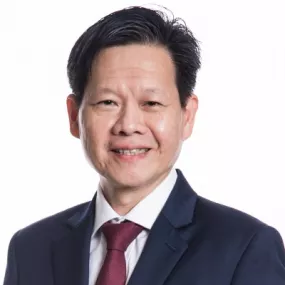
Mr. Chak Huat YEO
Vice-Chairman, SEMI Southeast Asia Advanced Product Testing Technical Committee | Senior Director, GlobalFoundries Singapore
Yeo Chak Huat is the Senior Director at GlobalFoundries, a leading semiconductor foundry that manufactures complex, feature-rich integrated circuits (ICs) that power billions of electronic devices across nearly every sector of the global economy.
In his role, he oversees the Worldwide Quality Failure Analysis (FA) analytical labs, establishes the global FA lab strategy, and supports key stakeholders in achieving the firm's mission of zero excursions and zero defects in all aspects of manufacturing and operations. He is a member of both the Corporate Quality Leadership and Site Leadership teams.
Previously, Chak Huat held various roles, including Head of Asia Quality, Head of Singapore post-fab operations, and Head of OSAT Operations and Business Management. He managed the worldwide outsourcing business, growing the OSAT business’s revenue to $300 million while ensuring operational and quality excellence.
With 35 years of experience in the semiconductor industry, Chak Huat's expertise spans wafer fabrication, wafer bumping, packaging, quality, testing, new product characterization, qualification, and production ramp. He holds a Bachelor’s Degree in Electrical and Electronic Engineering from the National University of Singapore.
Presentation Title
Harnessing AI/ML in the Semiconductor Foundry Chain to Improve Test Yield Outcome
Abstract
The global semiconductor industry took 50 years to reach a market value of $500 billion, but it is forecasted to double to $1 trillion in less than 10 years, by 2030. Artificial Intelligence (AI) is a key catalyst driving this exponential growth in semiconductor content.
This presentation will demonstrate the potential of deploying AI for early detection in the semiconductor value chain, aiming to provide predictable product yield outcomes, quality, and reliability control. It will discuss various use cases in manufacturing applications and the associated challenges.
Collaboration among partners is essential to fully harness the power of AI across the manufacturing value chain, which is currently segmented by design enablement, silicon fabrication, testing, and packaging due to different ownerships and intellectual property protection challenges. Establishing a common platform and standard is necessary to facilitate AI integration across the entire value chain.