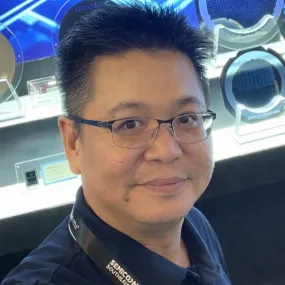
Dr. MC HSIEH
Director, Technology Marketing, STATS ChipPAC
Dr. MC Hsieh received the Ph. D. degree in aeronautics and astronautics engineering from the National Cheng Kung University, Taiwan in 2005. He is currently working as Director in Technology Marketing Division in STATS ChipPAC. Prior to join STATS ChipPAC, he was was a principal researcher in Industrial Technology Research Institute (ITRI), Taiwan. He has more than 20 years of industrial experience in semiconductor packaging area, includes flip chip, wafer level package, SiP, 2.5D/3D advanced package, thermal-mechanical simulation/characterization, failure analysis and reliability design. He has authored and co-authored over 70 scientific publications for journal and conference papers in the fields of semiconductor packaging, simulation & technology marketing.
Presentation Title
Scaling Chiplet Integration with Fine Line/Space Organic and Glass-Cored Substrates
The rapid development of Artificial Intelligence (AI) has accelerated the demand for scalable and high-performance computing architectures beyond the limitations of traditional SoC designs. The aggressive scaling of AI/HPC has driven a paradigm shift toward heterogeneous and chiplet integration. To enable high-yield chiplet integration with advanced substrate technology, this study presents developments utilizing the fine line/space organic substrate (2.1D substrate) and the glass-cored substrate.
The 2.1D substrate, incorporating nano-filler ABF materials, enables the fine bump pitch and line/space for chiplet integration and offers a cost-effective platform for AI/HPC applications. Furthermore, the glass-cored substrate provides superior dimensional stability and low dielectric loss characteristics facilitates larger package size with improved warpage control and robust high-speed signal transmission with reduced signal integrity degradation in chiplet integrations.
By systematically comparing these two advanced substrate approaches in chiplet integration, this study highlights their respective advantages as promising packaging solutions, aiming to balance cost and performance relative to 2.5D packaging technologies.
Back to Advanced Packaging & Heterogeneous Integration Summit